Best Tools to Build Scalable Cross-Platform Apps in 2026
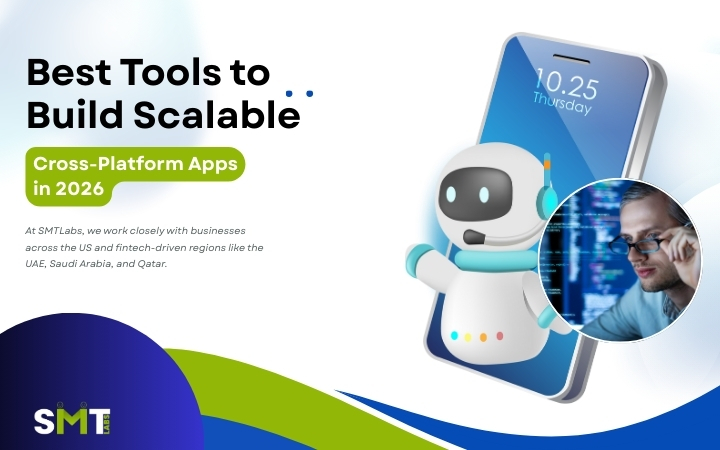
The way businesses build mobile apps has changed dramatically over the last few years, and by 2026, scalability and cross-platform performance are no longer optional—they’re survival tools. Whether you’re a startup founder in Dallas, a fintech innovator in San Francisco, or an enterprise leader expanding into Middle East markets, the pressure to launch fast, scale globally, and keep development costs under control is very real.
At SMTLabs, we work closely with businesses across the US and fintech-driven regions like the UAE, Saudi Arabia, and Qatar. One thing is crystal clear: choosing the right tools is just as important as choosing the right mobile app development company. The tools you select today will decide how well your product handles growth tomorrow.
In this blog, we’ll walk through the best tools to build scalable cross-platform apps in 2026, why they matter, and how top mobile app developers use them to deliver high-performing apps across industries like fintech, healthcare, and enterprise mobility.
Why Cross-Platform App Development Matters More Than Ever
Let’s be honest—building separate apps for iOS and Android in 2026 feels like driving two cars to the same destination. It’s expensive, slow, and inefficient. Cross-platform mobile app development services allow businesses to build once and deploy everywhere, without compromising performance or user experience.
For a mobile app development company in the USA, especially in competitive hubs like Chicago, Dallas, Austin, Los Angeles, and San Francisco, cross-platform frameworks are the backbone of modern app delivery. They help reduce mobile app development cost, speed up time to market, and simplify long-term maintenance.
This approach is especially powerful for industries like fintech mobile app development services, mobile banking app development, and healthcare mobile app development services, where scalability, security, and performance are non-negotiable.
Flutter: The Cross-Platform Powerhouse of 2026
Flutter has firmly established itself as one of the most reliable tools for cross-platform app development. Backed by Google, Flutter enables developers to build visually stunning apps using a single codebase while delivering near-native performance.
For businesses working with a top rated mobile app development company or a custom mobile app development company, Flutter is often the first choice. It supports complex UI designs, smooth animations, and high-performance rendering—making it ideal for fintech app development companies in San Francisco and enterprise-grade applications in the Middle East.
Flutter is also heavily used by mobile app development agencies offering flutter mobile app development services because it scales effortlessly as user bases grow. Whether you’re building a healthcare mobile app development solution or a fintech product targeting multiple regions, Flutter keeps performance consistent across platforms.
React Native: Trusted by Enterprises and Startups Alike
React Native continues to dominate the cross-platform space in 2026, especially for companies focused on rapid development and long-term scalability. Built and maintained by Meta, React Native allows developers to reuse most of the code across iOS and Android while still accessing native features.
Many mobile app development companies in Chicago, Dallas, and Austin rely on React Native for enterprise mobile app development projects. It integrates seamlessly with existing systems and works well for apps that demand real-time updates, complex workflows, and high user engagement.
For businesses looking to hire mobile app developers, React Native expertise is widely available, making it easier to scale development teams quickly. It’s also a popular choice among ChatGPT development companies in California that build AI-powered mobile applications.
SwiftUI & Kotlin Multiplatform: Hybrid Scalability for the Future
While fully cross-platform frameworks dominate, some custom mobile app development services now blend native and cross-platform approaches using SwiftUI and Kotlin Multiplatform.
Kotlin Multiplatform allows teams to share business logic across platforms while keeping native UI layers. This is especially useful for mobile banking app development and fintech mobile app development services, where performance and platform-specific security features are critical.
SwiftUI, on the other hand, streamlines iOS mobile app development by reducing boilerplate code and improving UI consistency. A forward-thinking iOS mobile app development company often combines SwiftUI with shared logic tools to achieve scalability without sacrificing native performance.
Unity & Unreal Engine for High-Performance Applications
Cross-platform isn’t limited to business apps anymore. Unity and Unreal Engine are now being used for interactive fintech dashboards, healthcare simulations, and immersive enterprise tools.
For a Los Angeles mobile app development company or a mobile app development agency working on AR, VR, or visualization-heavy projects, these engines offer unmatched performance. They scale effortlessly across mobile, tablet, and desktop environments, making them ideal for enterprise mobile app development and next-generation fintech experiences.
Firebase: The Backbone of Scalable App Infrastructure
No discussion about scalable apps is complete without Firebase. From authentication and cloud storage to real-time databases and analytics, Firebase acts as the backbone for many cross-platform apps.
Top mobile app development companies use Firebase to manage backend infrastructure without slowing down development. It’s particularly valuable for startups and fintech app development companies in Dallas and San Francisco that need to scale fast without building everything from scratch.
Firebase also integrates well with Flutter, React Native, and iOS mobile app development services, making it a go-to tool for mobile app development services USA-wide.
AWS Amplify & Azure: Enterprise-Grade Scalability
When apps grow beyond MVP stage, cloud infrastructure becomes critical. AWS Amplify and Microsoft Azure are widely used by enterprise-focused mobile app development companies in the USA.
These platforms support secure APIs, real-time data processing, AI integrations, and compliance-heavy industries like healthcare mobile app development and fintech mobile app development services. They’re especially popular among businesses targeting both US and Middle East markets, where data security and scalability standards are high.
AI-Powered Tools: The Rise of ChatGPT in App Development
AI is no longer a bonus feature—it’s a core component. ChatGPT development companies in California are leading the way in integrating conversational AI, predictive analytics, and automated customer support into mobile apps.
From fintech chatbots to healthcare virtual assistants, AI tools powered by ChatGPT APIs are transforming user experiences. A Chat GPT development company working alongside a mobile app development company in the USA can deliver smarter, more personalized applications at scale.
This trend is especially strong in fintech app development companies in San Francisco and Middle East fintech hubs, where AI-driven automation improves user trust and engagement.
CI/CD & DevOps Tools for Continuous Scalability
Scalable apps require scalable processes. Tools like GitHub Actions, Bitrise, Jenkins, and Fastlane are essential for modern mobile app development services.
These tools help mobile app developers automate testing, deployment, and updates across platforms. For a custom mobile app development company managing multiple clients, CI/CD pipelines ensure faster releases without sacrificing quality.
Security & Compliance Tools for Regulated Industries
Security is a deal-breaker in industries like fintech and healthcare. Tools like AppScan, Snyk, and Firebase App Check help mobile app development agencies maintain compliance and protect user data.
This is especially important for fintech mobile app development services targeting the US and Middle East, where regulations are strict and evolving.
Choosing the Right Toolset: It’s About Strategy, Not Trends
The best tools in 2026 aren’t about hype—they’re about alignment. A mobile app development company in Dallas might prioritize Flutter and Firebase for startups, while a fintech app development company in San Francisco may lean toward Kotlin Multiplatform, AWS, and AI integrations.
For businesses looking to build scalable products, partnering with a top rated mobile app development company that understands both technology and market dynamics is the real advantage.
Final Thoughts: Building for Scale Starts Today
Cross-platform app development in 2026 is no longer about cutting corners—it’s about building smarter. With the right tools, the right strategy, and the right mobile app development agency, businesses can launch apps that scale seamlessly across platforms, regions, and user demands.
Whether you’re exploring custom mobile app development services, planning enterprise mobile app development, or looking to hire mobile app developers for a fintech or healthcare project, the tools discussed here form the foundation of scalable success.
At SMTLabs, we believe scalable apps aren’t built by chance—they’re built with intention, experience, and the right technology stack.
FAQ
Recent Post


Popular Posts
-
Building the Future of Formalwear Retail with AI & 3D eCommerce
SMT Labs in AI & INNOVATION Sep 22, 2026 -
Why Healthcare App Development Is Transforming Patient Care
SMT Labs in HEALTHCARE Feb 19, 2026 -
How Generative AI Services Improve Customer Experience
SMT Labs in GENERATIVE AI Feb 09, 2026 -
Custom Fintech Software Development: The New Revolution in the Financial Industry
SMT Labs in DEVELOPMENT Apr 24, 2025 -
Fintech Application Development Company: Leading Services in Fintech App Development
SMT Labs in DEVELOPMENT Feb 20, 2025
 INDIA
INDIA  USA
USA  SOUTH AFRICA
  MAURITIUS