AI-Driven Features That Will Define Mobile Apps in 2026
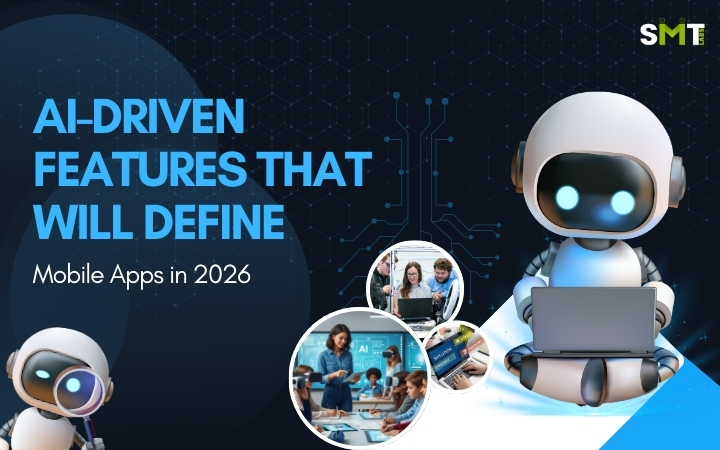
The mobile app world is changing faster than most people realize. What felt futuristic just a few years ago—voice assistants, predictive text, smart recommendations—has already become normal. Now, as we move closer to 2026, AI-driven mobile applications are stepping into a completely new league. Apps are no longer just tools; they’re becoming intelligent digital companions that learn, adapt, and evolve with users in real time.
For businesses in the US and the Middle East, especially those investing heavily in fintech app development, AI is no longer optional. Whether you’re working with an AI app development company in Dallas, a mobile app development company in Chicago, or a fintech app development company in San Francisco, the expectation is clear: apps must be smarter, faster, and deeply personalized.
This blog explores the AI-driven features that will define mobile apps in 2026, why they matter for businesses, and how companies like SMTLabs can leverage these innovations to stay ahead in competitive markets like the US, UAE, Saudi Arabia, and beyond.
Hyper-Personalization Powered by Contextual AI
By 2026, personalization will move far beyond basic user preferences. AI-driven apps will understand context—where users are, what they’re doing, how they’re feeling, and even what they’re likely to do next. This shift is powered by advanced machine learning models that process behavioral data in real time.
Imagine opening a fintech app that doesn’t just show your account balance but actively suggests smarter ways to save, invest, or pay bills based on your spending habits, income cycle, and financial goals. This level of intelligence is already being explored by every serious fintech app development company in San Francisco, where AI innovation is deeply embedded into product design.
For US-based enterprises and Middle Eastern fintech startups, contextual AI means:
- Smarter onboarding flows tailored to user intent
- Real-time content and feature adjustments
- Personalized notifications that feel helpful, not intrusive
A Los Angeles mobile app development company focusing on lifestyle or entertainment apps, for example, can use contextual AI to recommend content based on mood, time of day, or recent interactions. In 2026, users won’t tolerate generic experiences. Apps that fail to personalize deeply will simply be ignored.
Conversational AI Becoming the Primary User Interface
Typing and tapping are slowly giving way to conversations. By 2026, conversational AI will become one of the most dominant interfaces in mobile applications. Thanks to rapid advancements in natural language processing, users will talk to apps the same way they talk to people.
This is where ChatGPT development company in California services are seeing massive demand. Businesses want custom conversational AI that understands industry-specific language—especially in fintech, healthcare, and eCommerce.
Unlike traditional chatbots, AI-powered conversational interfaces will:
- Understand complex, multi-step queries
- Maintain conversation history and context
- Respond with human-like tone and accuracy
In fintech apps targeting the US and Middle East, conversational AI will allow users to:
- Ask questions about transactions in plain English
- Get instant financial advice
- Resolve issues without waiting for human support
A forward-thinking Chat gpt development company can integrate these features seamlessly into mobile apps, making them feel intuitive and approachable. In 2026, if your app can’t talk back intelligently, it will feel outdated.
Predictive Intelligence That Anticipates User Needs
One of the most powerful AI-driven features shaping mobile apps in 2026 is predictive intelligence. Instead of reacting to user actions, apps will proactively anticipate what users need next.
This is especially critical for fintech and enterprise apps. A smart banking app might predict a cash flow shortage before it happens and suggest solutions. A retail app could predict when a user is likely to reorder a product and offer a timely discount.
Leading teams at a mobile app development company in Chicago are already building systems that:
- Analyze historical data patterns
- Detect anomalies in user behavior
- Trigger proactive recommendations
For Middle Eastern fintech platforms operating in fast-growing economies, predictive AI helps manage risk, prevent fraud, and improve customer trust. Users don’t just want speed—they want foresight. Apps that can “think ahead” will dominate in 2026.
AI-Driven Security and Fraud Prevention
As mobile apps become more intelligent, so do cyber threats. By 2026, AI-driven security will be a defining feature, especially for fintech and enterprise-grade applications.
Traditional security methods like passwords and OTPs are no longer enough. AI enables behavioral biometrics, which analyze how users type, swipe, and interact with their devices. This creates a unique behavioral fingerprint that’s extremely hard to replicate.
A trusted AI app development company in Dallas can implement:
- Real-time fraud detection models
- Continuous authentication using user behavior
- Adaptive security protocols based on risk level
For fintech apps serving users in the US, UAE, and Saudi Arabia, AI-driven security ensures compliance with strict regulations while maintaining a smooth user experience. In 2026, the best security will be invisible—working silently in the background without disrupting users.
Autonomous App Workflows and Decision-Making
One of the most exciting developments in AI-driven mobile apps is autonomy. By 2026, apps won’t just assist users—they’ll take action on their behalf.
Think of a personal finance app that automatically reallocates funds based on market conditions or a business app that optimizes workflows without manual input. This level of autonomy is made possible by reinforcement learning and advanced decision-making algorithms.
A fintech app development company in San Francisco focusing on automation can help businesses:
- Reduce operational costs
- Eliminate repetitive user actions
- Improve efficiency through AI-led decisions
For enterprises across the US and Middle East, autonomous apps mean faster processes, fewer errors, and better outcomes. However, transparency and control will be critical. Users must always understand and trust the decisions their apps are making.
Emotionally Intelligent AI Experiences
By 2026, AI won’t just understand what users say—it will understand how they feel. Emotion AI uses voice tone analysis, facial recognition (where permitted), and behavioral cues to detect emotional states.
This has massive implications for customer experience. An app that senses frustration can adjust its responses, offer help, or simplify the interface instantly. A Los Angeles mobile app development company working on wellness or customer service apps can use emotion AI to create deeply empathetic experiences.
In fintech apps, emotional intelligence can:
- Calm anxious users during financial stress
- Provide reassurance during high-risk transactions
- Improve long-term user engagement
For markets like the US and Middle East, where user trust is critical, emotionally intelligent AI will be a major differentiator.
Cross-Platform AI Consistency
Users don’t live on one device anymore. They move seamlessly between smartphones, tablets, wearables, and even cars. By 2026, AI-driven mobile apps must offer consistent intelligence across platforms.
This means your AI assistant should remember conversations, preferences, and actions regardless of where the interaction happens. Achieving this requires robust backend AI systems—something a skilled ChatGPT development company in California or enterprise AI partner can deliver.
For global businesses targeting both US and Middle Eastern users, cross-platform AI ensures:
- Unified user experience
- Better data synchronization
- Higher brand loyalty
Apps that feel fragmented across devices will quickly lose relevance.
AI-Powered Localization for Global Markets
Localization in 2026 will go far beyond language translation. AI-powered localization will adapt content, UX, and even features based on cultural norms, regional regulations, and user behavior.
This is particularly important for fintech apps targeting the Middle East alongside the US. AI can dynamically adjust:
- Currency formats and financial terminology
- Compliance workflows based on region
- UI layouts based on cultural preferences
A globally focused mobile app development company in Chicago or Dallas can use AI to scale apps efficiently across markets without rebuilding from scratch. Localization will no longer be manual—it will be intelligent and automatic.
Why AI-Driven Apps Matter for Businesses in 2026
The question is no longer if AI will define mobile apps—it’s how well it will be implemented. Businesses that partner with the right AI app development company in Dallas, Chat gpt development company, or fintech specialists will gain a significant competitive edge.
For SMTLabs and similar innovation-driven teams, AI offers:
- Faster product innovation
- Higher user retention
- Smarter decision-making
- Stronger global reach
In both the US and Middle East, customers expect intelligent, secure, and personalized experiences. AI is the foundation that makes all of this possible.
Conclusion: The Future of Mobile Apps Is Intelligent, Human, and Predictive
By 2026, mobile apps will no longer feel like static software. They will feel alive—learning from users, adapting to their needs, and anticipating their next move. From conversational interfaces and predictive intelligence to emotionally aware experiences and autonomous workflows, AI-driven features will define the next generation of mobile applications.
For businesses working with a fintech app development company in San Francisco, a Los Angeles mobile app development company, or a ChatGPT development company in California, now is the time to invest in AI-first strategies. The apps built today will shape how users interact with technology tomorrow.
The future belongs to mobile apps that think, feel, and evolve—and 2026 is just the beginning.
FAQ
Recent Post


Popular Posts
-
Building the Future of Formalwear Retail with AI & 3D eCommerce
SMT Labs in AI & INNOVATION Sep 22, 2026 -
Why Healthcare App Development Is Transforming Patient Care
SMT Labs in HEALTHCARE Feb 19, 2026 -
How Generative AI Services Improve Customer Experience
SMT Labs in GENERATIVE AI Feb 09, 2026 -
Custom Fintech Software Development: The New Revolution in the Financial Industry
SMT Labs in DEVELOPMENT Apr 24, 2025 -
Fintech Application Development Company: Leading Services in Fintech App Development
SMT Labs in DEVELOPMENT Feb 20, 2025
 INDIA
INDIA  USA
USA  SOUTH AFRICA
  MAURITIUS