Why Businesses Are Investing in AI Software Development
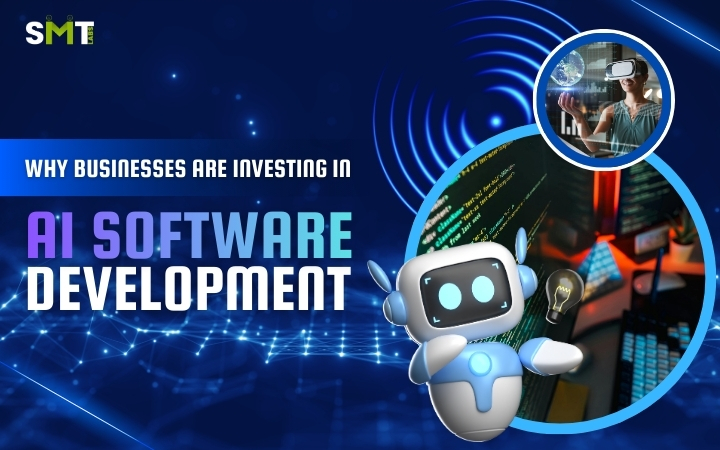
Artificial Intelligence (AI) is no longer a futuristic concept reserved for tech giants or research labs. Today, it has become a practical, powerful business tool that organizations of all sizes are actively adopting. From automating routine tasks to delivering intelligent customer experiences, AI is reshaping how companies operate, compete, and grow.
As digital transformation accelerates, businesses are increasingly investing in AI software development to stay relevant in a data-driven world. AI-powered solutions help organizations make smarter decisions, improve efficiency, reduce costs, and unlock new opportunities that traditional software simply cannot deliver.
In this blog, we explore why businesses across industries are prioritizing AI software development, how it delivers real value, and what makes it a strategic long-term investment.
The Growing Importance of AI in Modern Business
Modern businesses operate in an environment defined by speed, data, and constant change. Customers expect personalized experiences, markets evolve rapidly, and competition is more intense than ever. Traditional software systems, while still essential, are often limited by static logic and predefined rules.
AI changes this equation. Instead of merely following instructions, AI-powered software can learn from data, adapt to new patterns, and improve over time. This ability to “think” and evolve is what makes AI so valuable for modern organizations.
Businesses are no longer asking if they should adopt AI—they are asking how fast they can do it without falling behind competitors.
What Is AI Software Development?
AI software development refers to the process of designing, building, and deploying applications that simulate human intelligence. These systems can analyze data, recognize patterns, make predictions, and automate complex decision-making.
Unlike traditional software, which relies on fixed rules, AI software uses data-driven models to learn and improve continuously.
Key Components of AI Software Development
Machine Learning (ML): Enables systems to learn from data and improve accuracy over time
Natural Language Processing (NLP): Allows software to understand and respond to human language
Computer Vision: Helps systems interpret images and videos
Predictive Analytics: Uses historical data to forecast future outcomes
Together, these technologies enable businesses to build intelligent applications that adapt to real-world conditions.
What’s Driving Businesses to Adopt AI Software Development?
Several factors are accelerating the demand for AI-powered solutions.
Explosion of Business Data
Every business today generates massive amounts of data—from customer interactions and transactions to operational metrics. AI software helps convert this raw data into meaningful insights that drive smarter decisions.
Demand for Faster Decision-Making
In competitive markets, delayed decisions can result in lost opportunities. AI enables real-time analysis and automated responses, helping businesses act quickly and confidently.
Rising Customer Expectations
Customers now expect personalized, responsive, and seamless experiences. AI-powered applications make it possible to tailor products, services, and communication to individual users.
Need for Automation and Efficiency
Manual processes are time-consuming and error-prone. AI automates repetitive tasks, freeing teams to focus on strategic and creative work.
Competitive Pressure
As more companies invest in AI software development, those that don’t risk falling behind. AI has become a key differentiator in innovation and performance.
Business Benefits of AI Software Development
Investing in AI software development delivers measurable benefits across multiple areas of business operations.
Improved Operational Efficiency
AI automates workflows, reduces manual intervention, and optimizes processes. This leads to faster execution and better resource utilization.
Cost Reduction
By minimizing human effort in repetitive tasks and reducing errors, AI-powered systems help businesses lower operational costs over time.
Data-Driven Insights
AI software analyzes large datasets to uncover trends, patterns, and opportunities that may not be visible through traditional analytics.
Enhanced Accuracy and Consistency
AI systems reduce the risk of human error, especially in tasks involving large-scale data analysis or repetitive decision-making.
Better Customer Experiences
From chatbots and recommendation engines to personalized marketing, AI enhances customer engagement and satisfaction.
AI Software Development Use Cases Across Industries
AI software development is not limited to one sector. Its applications span across industries, delivering value in diverse ways.
Healthcare
AI helps analyze medical data, assist in diagnostics, manage patient records, and improve treatment outcomes.
Finance
Banks and financial institutions use AI for fraud detection, risk assessment, algorithmic trading, and customer service automation.
Retail and E-commerce
AI enables personalized recommendations, demand forecasting, dynamic pricing, and inventory optimization.
Manufacturing
Predictive maintenance, quality control, and process optimization are powered by AI-driven insights.
Customer Support
AI chatbots and virtual assistants provide instant responses, reduce support workload, and improve customer satisfaction.
These real-world applications demonstrate why businesses view AI as a strategic asset rather than a technological experiment.
The Role of Custom AI Software Development
While off-the-shelf AI tools are available, many businesses choose custom AI software development to meet their specific needs.
Limitations of Pre-Built Solutions
Generic AI tools may not align perfectly with unique business processes, data structures, or long-term goals.
Advantages of Custom AI Solutions
Tailored to specific business challenges
Better integration with existing systems
Greater scalability and flexibility
Full control over data, logic, and performance
Custom AI software ensures that technology works for the business, not the other way around.
Technologies and Tools Powering AI Software Development
AI software development relies on a combination of advanced tools and platforms, including:
Machine learning frameworks for model training
Data analytics and processing platforms
Cloud infrastructure for scalability
APIs for system integration
Databases optimized for large datasets
Choosing the right technology stack is critical for performance, security, and future scalability.
Challenges in AI Software Development
Despite its benefits, AI software development comes with challenges that businesses must address.
Data Quality and Availability
AI systems are only as good as the data they learn from. Poor data quality can limit effectiveness.
Talent and Skill Gaps
AI development requires specialized expertise in data science, machine learning, and system architecture.
Integration Complexity
Integrating AI solutions with existing software systems can be technically demanding.
Security and Ethical Considerations
Data privacy, bias, and responsible AI use are critical concerns that require careful planning.
Understanding these challenges helps businesses make informed decisions and plan effectively.
Why Businesses Choose AI Software Development Partners
Many organizations partner with experienced AI development teams to overcome challenges and accelerate results.
Access to Skilled Professionals
AI partners bring specialized expertise that may not be available in-house.
Faster Time-to-Market
Experienced teams reduce development time and implementation risks.
Cost-Effective Development
Outsourcing AI software development eliminates the need for long-term internal hiring and training.
Ongoing Support and Optimization
AI systems require continuous monitoring, updates, and improvement—something professional partners handle efficiently.
The Future of AI Software Development
AI is rapidly becoming a core business capability rather than an optional enhancement. As technology evolves, AI-powered applications will become more intelligent, autonomous, and integrated into everyday business operations.
Businesses that invest early in AI software development gain a long-term advantage by building scalable systems that adapt to future demands. Those that delay adoption risk struggling to catch up in an increasingly AI-driven market.
Conclusion: AI Software Development as a Strategic Investment
AI software development is no longer about experimentation—it’s about transformation. Businesses are investing in AI to improve efficiency, unlock insights, enhance customer experiences, and future-proof their operations.
By adopting AI-powered solutions today, organizations position themselves for sustainable growth, innovation, and competitive success tomorrow. Whether through automation, predictive analytics, or intelligent decision-making, AI is shaping the future of business.
Recent Post


Popular Posts
-
Building the Future of Formalwear Retail with AI & 3D eCommerce
SMT Labs in AI & INNOVATION Sep 22, 2026 -
Why Healthcare App Development Is Transforming Patient Care
SMT Labs in HEALTHCARE Feb 19, 2026 -
How Generative AI Services Improve Customer Experience
SMT Labs in GENERATIVE AI Feb 09, 2026 -
Custom Fintech Software Development: The New Revolution in the Financial Industry
SMT Labs in DEVELOPMENT Apr 24, 2025 -
Fintech Application Development Company: Leading Services in Fintech App Development
SMT Labs in DEVELOPMENT Feb 20, 2025
 INDIA
INDIA  USA
USA  SOUTH AFRICA
  MAURITIUS